Energy-Saving Blinds: Which Window Coverings Really Keep the Heat In?
When the heating is on but a room still feels chilly, the windows are often part of the problem. Even modern double glazing allows some heat to escape, and sitting beside a large expanse of glass can feel noticeably colder than sitting elsewhere in the room.
For homes across Chesterfield, Buxton and the Peak District, particularly those with large windows, older glazing or exposed locations, choosing the right window covering can make a worthwhile difference to winter comfort.
Energy-saving blinds are not simply a marketing claim. Independent research has demonstrated that certain blinds and shutters can significantly reduce heat loss through windows. However, the type of covering, fabric construction and method of fitting all influence the result.
So, which window coverings are worth considering, and how do you choose the right one for your home?
How Much Heat Can Blinds Actually Save?
Research commissioned by the British Blind and Shutter Association (BBSA) and conducted at the University of Salford's Energy House Laboratory provides some useful answers.
Tests on a modern double-glazed, low-emissivity window found reductions in heat loss of up to:
- 33% with a specialist roller blind using zipped side channels and low-emissivity fabric.
- 32% with a blackout honeycomb blind fitted into a frame designed to minimise gaps.
- 28% with internal plantation shutters.
- 13% with a standard roller blind.
These are reductions in heat loss through the tested window, compared with the same window without a covering. They are not percentages that can be applied directly to household heating bills, and results will vary depending on the glazing, blind specification and installation.
Nevertheless, the findings confirm something important: even homes with modern double glazing can benefit from insulating window coverings.
You can read the findings in the BBSA's independent energy-saving research.
Duette Honeycomb Blinds: Designed for Better Insulation
One of the most effective approaches to insulating a window is to introduce a layer of relatively still air between the glass and the room.
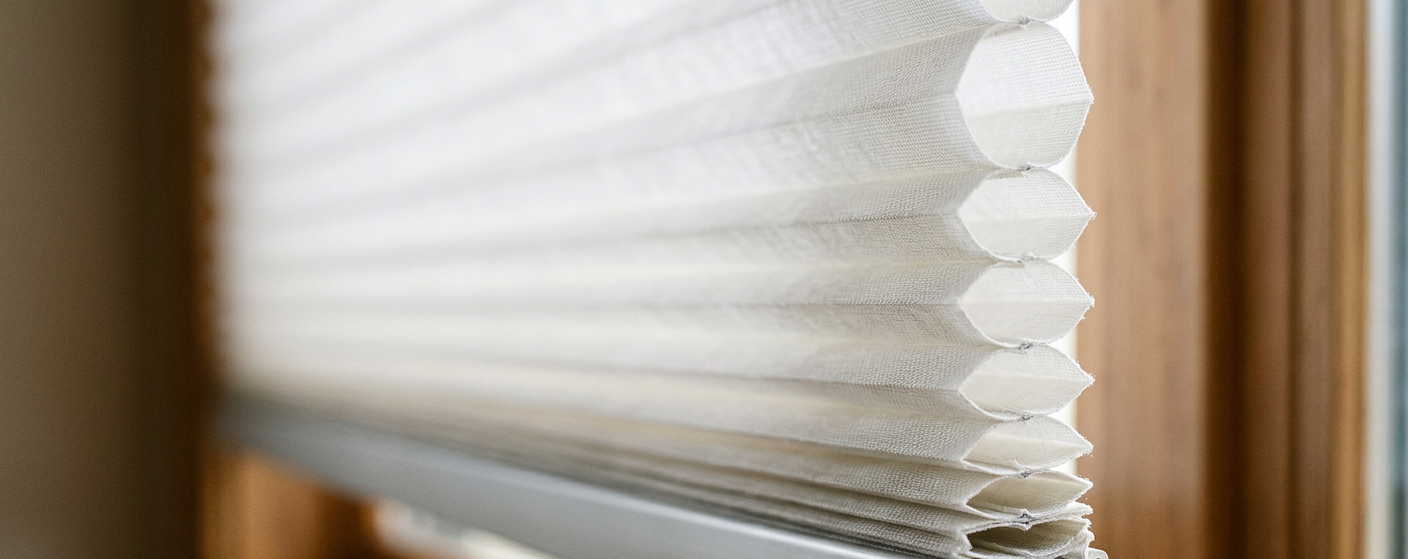
This is the principle behind Duette honeycomb blinds.
Unlike a conventional pleated blind, which uses a single folded layer of material, Duette blinds feature a cellular construction. The honeycomb-shaped pockets hold air within the fabric, helping to slow heat transfer.
As an established Luxaflex Gallery Dealer, Etienne offers Duette blinds in a wide selection of fabrics, colours and operating systems.
They are particularly worth considering for bedrooms, living rooms and glazed extensions where maintaining a comfortable temperature is important.
Are All Honeycomb Blinds Equally Efficient?
Not necessarily.
Cell size, fabric construction, additional internal layers and fitting methods can influence performance. For example, Luxaflex also offers Duette Architella, which features a honeycomb-within-a-honeycomb construction with three air pockets.
Luxaflex reports that independent testing by the Fraunhofer Institute for Building Physics found reductions in heat loss through windows of up to 55% for its Architella system under the tested conditions.
That figure comes from a different test programme from the BBSA research and should not be compared as though the products were tested identically.
The important consideration is choosing the right product and installation arrangement rather than assuming every cellular blind offers identical thermal performance.
Window Shutters: Insulation, Privacy and Light Control
Interior shutters are another option for homeowners looking to improve comfort around their windows.
When the panels and louvres are closed, shutters create an additional barrier between the room and the glazing. Their frame and panel construction can help reduce heat transfer while providing useful privacy and light control.
The BBSA's independent testing recorded a 28% reduction in heat loss through the window with the particular plantation shutter system tested.
At Etienne, our made-to-measure shutters are available in different styles and materials, including hardwood, MDF and composite options.
For properties with traditional sash windows or attractive bay windows, shutters can be particularly appealing because they follow the shape of the opening without requiring full-length curtains.
However, the style matters.
Full-height shutters provide coverage across the complete window when closed, whereas café-style shutters cover only the lower section. Café-style shutters are excellent for daytime privacy but won't provide the same full-window thermal barrier.
The frame design, number of panels, louvre closure and any gaps around the installation are all worth considering.
What About Roller Blinds and Curtains?
You don't necessarily need a specialist cellular blind to improve comfort at your windows.
Roller Blinds
A conventional roller blind introduces another layer between the glass and the room. Although its insulating performance may be more modest, the BBSA tests demonstrated that even a standard roller blind can reduce heat loss.
Fabric construction and fitting make a difference. A roller blind that sits some distance from the glazing with generous gaps around its edges may allow air to circulate more freely than a closely fitted alternative.
Etienne manufactures its own made-to-measure roller blinds in Chesterfield, allowing customers to choose fabrics and finishes suited to their windows and requirements.
Made-to-Measure Curtains
Curtains are also worth considering, especially where a room needs a softer finish or the windows are unusually tall or wide.
Lined and interlined curtains can add useful insulation, although their effectiveness depends on fabric construction, coverage and how closely they fit around the window.
For example, full-length curtains hanging over a radiator may interfere with the circulation of warm air into the room when closed.
A more effective arrangement may be curtains that cover the window generously without obstructing the heating system.
Our made-to-measure curtain service allows customers to discuss fabric, lining, heading styles and fitting positions together.
Why the Fitting Can Matter as Much as the Fabric
The independent testing highlights a point that is easily overlooked when buying blinds: the best-performing systems are not simply those with the thickest fabric.
Reducing unwanted air movement around the covering can be just as important.
A blind fitted closely within the window recess will behave differently from one positioned well forward of the glass. Similarly, a framed cellular blind may perform differently from a free-hanging version of a similar fabric.
This is why professional measuring and installation are worth considering, particularly where thermal performance is a priority.
At Etienne, we look at the complete window rather than choosing a product from its appearance alone.
That includes checking the available recess depth, handles, opening windows, glazing layout and whether a frame-mounted or free-hanging blind is appropriate.
The aim is to improve coverage while retaining practical access to the window and its ventilation facilities.
Getting More from Your Blinds During Winter
How you use your blinds can also influence their effectiveness.
On bright winter days, opening the blinds allows useful daylight and solar warmth into the room. Even when the outside temperature is low, sunlight entering through the glazing may provide some welcome additional warmth.
As daylight fades, closing the blinds creates an additional insulating layer between the room and the colder window.
This simple routine is particularly useful in rooms that receive good daytime sunlight.
Motorised blinds can make regular adjustment more convenient, especially on high windows, roof glazing or large groups of blinds. Where the chosen system supports it, scheduled operation can help ensure blinds are closed in the evening without having to adjust each one individually.
Blinds are not, however, a substitute for draught-proofing damaged windows, repairing failed glazing seals or maintaining adequate ventilation. If condensation is a concern, avoid trapping moisture against cold glass for prolonged periods.
Energy-Saving Blinds Also Have Summer Benefits
Although winter insulation is the immediate priority, good thermal window coverings can also be useful during warmer months.
Cellular blinds can help reduce heat transfer through the glazing, while suitable reflective or solar-control fabrics can limit some incoming solar energy.
In conservatories, garden rooms and modern extensions with large areas of glass, the choice of fabric and the direction the windows face are particularly important.
For substantial summer overheating, externally fitted shading may be more effective because it intercepts sunlight before it passes through the glass.
Choosing a window covering with both winter and summer performance in mind can therefore provide better value throughout the year.
Which Energy-Saving Blinds Are Best for Your Home?
There isn't one answer that suits every property.
For a bedroom where insulation and room darkening are priorities, a closely fitted cellular blind may be an excellent option.
For a period property with attractive sash or bay windows, shutters may offer the preferred combination of privacy, thermal performance and appearance.
In a living room where soft furnishings are important, lined or interlined curtains may be more suitable, potentially combined with a blind for additional light control.
And for a modern kitchen or glazed extension, the answer may depend on how the windows open, their dimensions and whether motorised control would make everyday operation easier.
The most useful starting point is to identify where the room loses comfort, how the windows are used and what you need the covering to achieve.
Expert Advice on Energy-Saving Blinds in Chesterfield and Derbyshire
Established in 1991, Etienne Curtains & Blinds has extensive experience supplying and installing made-to-measure window coverings throughout Chesterfield, Buxton, Bakewell, the Peak District and surrounding areas.
As a Luxaflex Gallery Dealer, we can advise on specialist Duette honeycomb blinds alongside our wider range of shutters, roller blinds and curtains.
Whether you're looking to make a cold bedroom more comfortable, improve insulation around large windows or simply understand which products offer genuine thermal benefits, we'll help you compare the options.
Visit our Chesterfield showroom or contact Etienne to arrange expert advice and discuss the most suitable energy-saving blinds or shutters for your home.

